
There is a simple but underappreciated fact about autonomous driving: most of the data is not where most of the learning is.
Ordinary driving video is necessary. But the safety-critical behavior of the system is often determined by rarer cases: something enters the road unexpectedly, an actor is partially hidden, or the physical conditions make the normal response unsafe.
The long tail is not a decorative add-on to autonomous driving. It is one of the central problems.
Rare Events Contain More Information Than Normal Miles
Consider three examples:
| Scenario | Why it matters |
|---|---|
| Animal entering the road | The actor does not follow traffic rules, and its future motion is hard to predict |
| Motorcyclist in the blind spot | The actor is small, close, partly occluded, and safety-critical |
| Motorcyclist in wet conditions | Perception, friction, braking distance, and vulnerable-road-user risk all interact |
Each clip is short. But each one forces the model to confront a problem almost absent from ordinary driving: a sudden object in the lane, a motorcycle at the edge of the camera view, a wet road where the same braking policy no longer has the same outcome.
1. An Animal Enters the Road
The first clip looks unremarkable until the relevant moment appears.
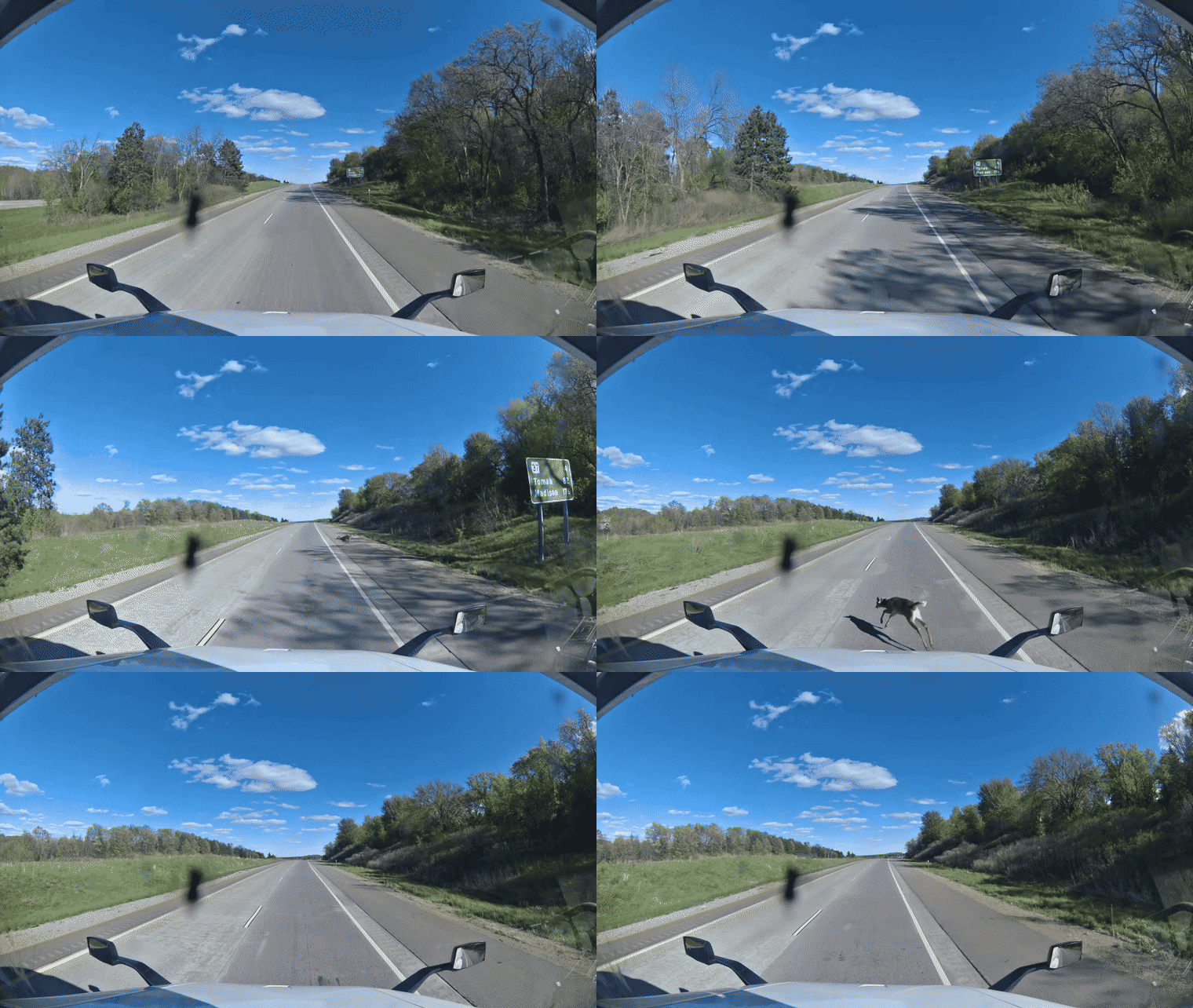
This is not primarily a classification problem. It is a prediction and uncertainty problem.
An animal near the road is not like another car. It does not stay in a lane, signal, or follow traffic priors. It may stop, retreat, cross, hesitate, or change direction in a way that is locally coherent but hard to infer.
A good driving model needs to learn that movement from outside the lane can become immediately relevant, that non-vehicle actors require different behavioral assumptions, and that slowing early can be correct even before the hazard is centered.
The important thing is temporal context. The model needs the before, not only the after. By the time the object is directly in front of the vehicle, much of the decision-making window has already passed.
2. A Motorcyclist Appears Near the Blind Spot
The second clip shows a dense urban scene where a motorcyclist appears near the edge of the vehicle's field of view.
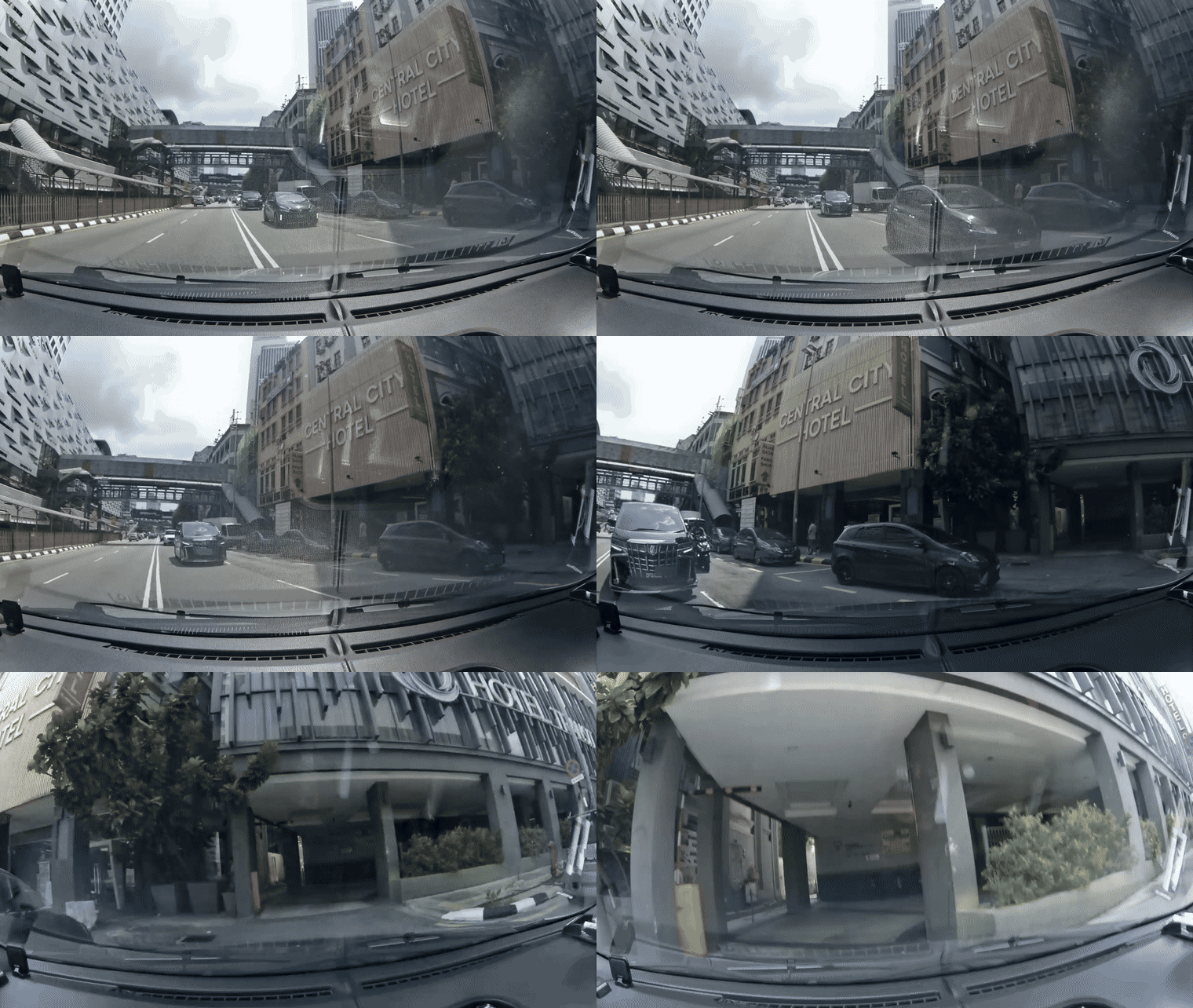
Motorcycles matter disproportionately because they are small, fast, and fragile. They can occupy ambiguous space, accelerate into gaps quickly, and be partially occluded by traffic or by the camera geometry itself.
The point is not just that the model should detect "motorcycle." It should assign the right level of risk to a small actor near the edge of perception, while handling peripheral perception, occlusion, relative speed, and conservative planning around vulnerable road users.
In ordinary datasets, a model may see motorcycles. What it sees less often are the exact moments where the motorcycle is close, ambiguous, partially hidden, and consequential.
3. A Motorcycle Scenario Under Wet Conditions
The third clip adds another variable that is easy to underestimate: the road surface.
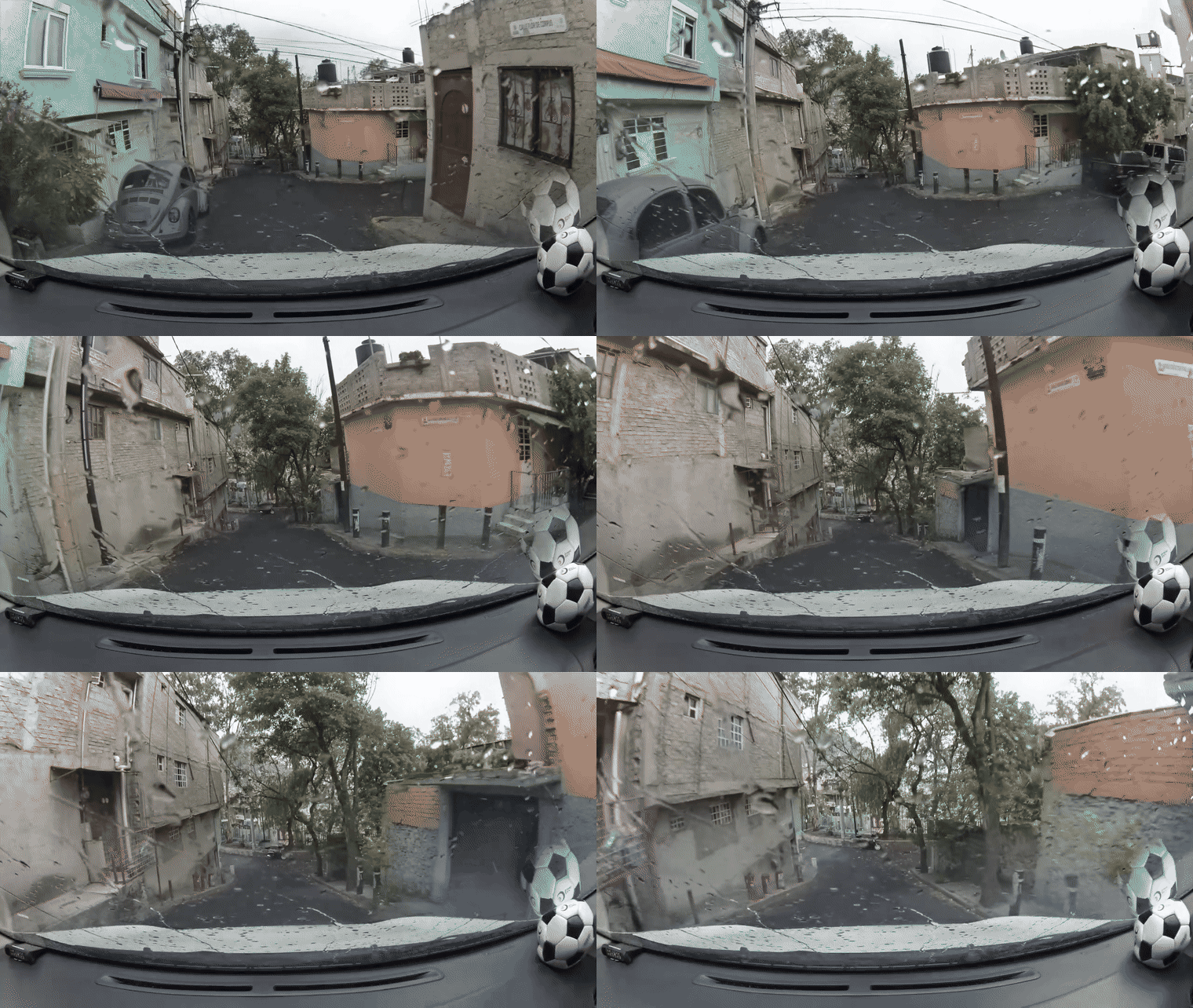
Wet roads turn the same visual scene into a different control problem. Braking distances increase, reflections make perception harder, camera clarity can degrade, and road boundaries become less legible.
For a driving model, this is where perception and physics have to be learned together. It is not enough to identify the motorcycle or scooter. The model has to learn that the policy should change because the environment changed.
The model needs examples where vulnerable-road-user behavior, road geometry, visibility, and surface condition are all present in the same sequence. These clips are valuable because they are interactions, not single labels.
What Large Fleets Reveal
This is the gold that Tesla vehicles collect every day.
The value is not merely that the fleet records many miles. A large deployed fleet naturally encounters the rare distribution: strange animals, unusual merges, complicated motorcycle behavior, wet roads, construction changes, bad human decisions, and combinations between them.
That data is valuable because the events are real. They include the visual messiness, timing, camera artifacts, hesitation, and physical constraints that are easy to simplify away in simulation.
For teams building AV systems or driving world models, this creates a serious asymmetry. Organizations with large real-world fleets can mine the long tail continuously. Everyone else has to work much harder to find the same examples.
This is why event-triggered collection matters. It changes the problem from "store everything and search later" to "detect high-information moments as they happen."
Organize the Dataset Around Failure Modes
The right unit of data is not just a mile. It is a scenario.
A dataset organized only by geography and time will contain important combinations, but they will be buried: animal plus highway speed, motorcycle plus blind spot, pedestrian plus glare, wet pavement plus narrow street, construction plus lane ambiguity.
The model-building workflow is iterative. When a system fails on a class of scenarios, the team needs to find more of that class, retrain, evaluate again, and repeat. The faster that loop runs, the faster the model improves.
What AI Event Videos Are For
AI Event Videos exist for this loop.
Instead of treating video as an undifferentiated archive, the system preserves moments that are more likely to matter: sudden braking, swerving, vulnerable-road-user proximity, unusual actor behavior, and other safety-relevant events.
The useful object is not a random dashcam clip. It is a structured example: what happened, when it happened, where it happened, what the surrounding context looked like, and how the ego vehicle and other actors moved through the scene.
That structure makes the data useful for training, evaluation, and simulation. Models need rare, real examples of the behaviors they are expected to handle, and safety claims need to be tested against scenarios that are actually difficult.
The broader point is that the long tail should not be an afterthought. It should be a first-class object in the data system.
The Direction of Travel
Autonomous driving will not be solved by scaling ordinary driving data alone.
Scale matters, but composition matters too. A billion normal frames can still leave a model underprepared when an animal enters the road, a motorcyclist appears at the edge of the camera view, or a wet street changes the physics of the scene.
The systems that improve fastest will be the ones that continuously find these cases, preserve them, structure them, and feed them back into training and evaluation.
In that sense, a fleet is not just a fleet. It is an instrument for discovering the parts of reality that models are least likely to understand by default.
Follow us on X or Try Bee Maps for Free.