
Fleet safety isn't abstract. It's measured in milliseconds — the split-second gap between a normal stop and a white-knuckle emergency brake that sends everything in the cab flying forward.
We dug into over 10,000 harsh braking events detected by Bee Maps AI across our global dashcam fleet. Using speed telemetry from each event, we ranked every single one by the size of the speed drop — from cruising velocity to near-standstill — to find the most extreme braking moments caught on camera.
Here are the top 5, along with what they reveal about where and why the hardest stops happen.
#1 — The Autobahn Emergency: 109 mph to 29 mph
Speed drop of 81 mph over 1,837 feet | Near Bad Camberg, Hesse, Germany
This is the single most violent braking event in our dataset. A vehicle cruising at nearly 110 mph on the German Autobahn slammed the brakes and shed 81 mph over roughly a third of a mile — that's more than six football fields of tires fighting asphalt. At those speeds, even a brief hesitation in reaction time covers enormous distance. The Autobahn has no general speed limit, but that freedom demands flawless attention — and this clip shows what happens when something unexpected appears at triple-digit velocity.
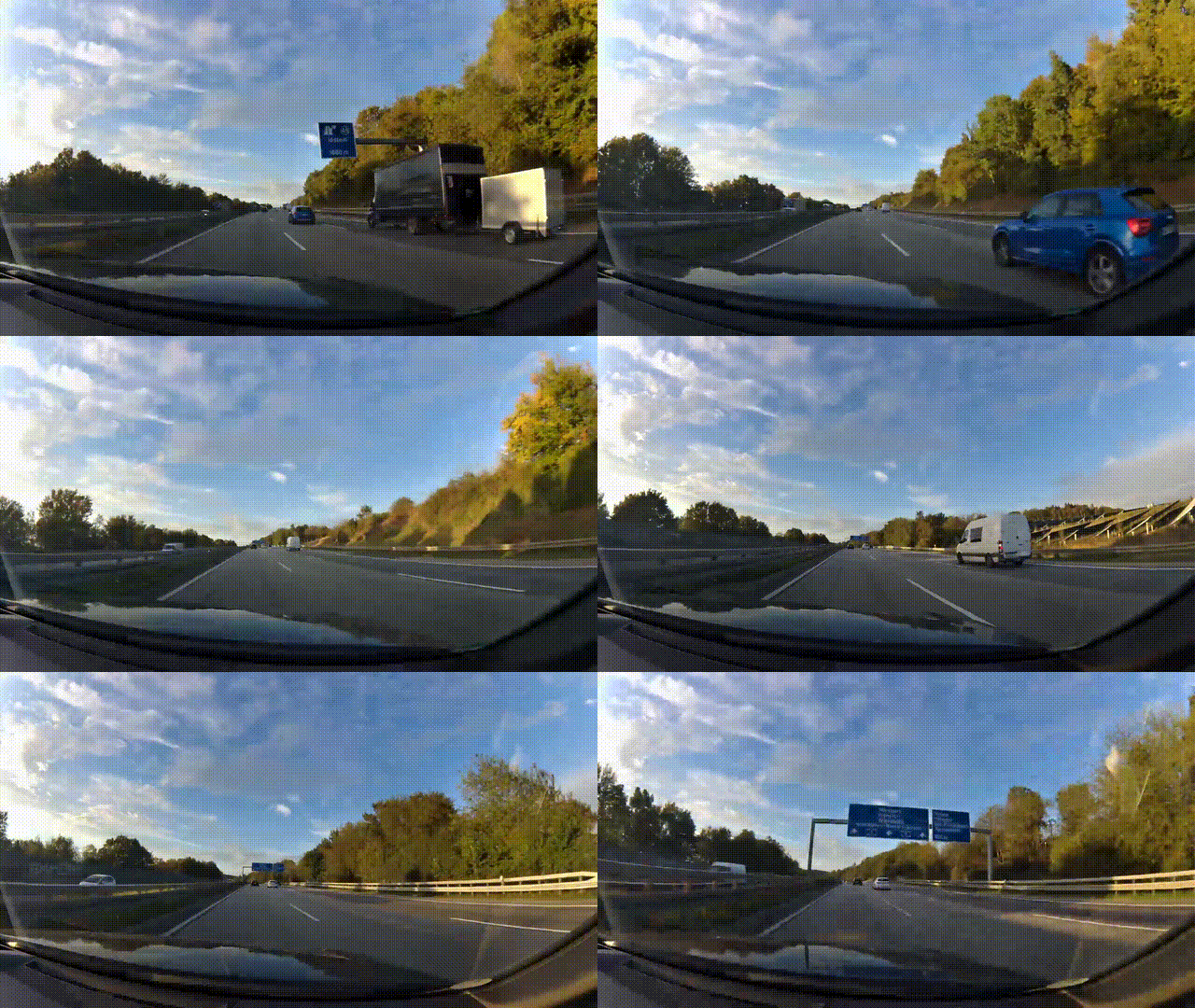
Metadata
| # | Latitude | Longitude | Altitude | Time |
|---|---|---|---|---|
| 1 | 50.221376 | 8.251076 | 389.1m | 5:49:29 AM |
| 2 | 50.219774 | 8.250749 | 398.0m | 5:49:33 AM |
| 3 | 50.218003 | 8.250337 | 405.6m | 5:49:38 AM |
| 4 | 50.216143 | 8.249999 | 408.9m | 5:49:42 AM |
| 5 | 50.214952 | 8.250066 | 409.0m | 5:49:46 AM |
| 6 | 50.214183 | 8.250233 | 409.5m | 5:49:51 AM |
| 7 | 50.213562 | 8.250384 | 410.1m | 5:49:55 AM |
| 8 | 50.213001 | 8.250522 | 410.6m | 5:49:59 AM |
Try this API query
curl https://beemaps.com/api/developer/aievents/68d2352114aa704d3a5cf339\
?includeGnssData=true\&includeImuData=true \
  -H "Authorization: Basic <your-api-key>"
#2 — The Rural Texas Lockup: 75 mph to 0 mph
Speed drop of 75 mph over 753 feet | Near Comanche, Texas, USA
A complete stop from full highway speed in just 753 feet — roughly two and a half football fields. On a rural Texas two-lane road at 4 AM, the vehicle went from 75 to zero, suggesting an obstacle appeared suddenly with no room to maneuver. Rural roads like these often lack shoulders, median barriers, and lighting, making unexpected hazards (animals, stopped vehicles, debris) especially dangerous at full speed.

Metadata
| # | Latitude | Longitude | Altitude | Time |
|---|---|---|---|---|
| 1 | 31.861682 | -98.922083 | 444.0m | 3:56:11 AM |
| 2 | 31.860423 | -98.922489 | 443.1m | 3:56:15 AM |
| 3 | 31.859159 | -98.922894 | 440.8m | 3:56:19 AM |
| 4 | 31.857892 | -98.923297 | 437.9m | 3:56:24 AM |
| 5 | 31.856770 | -98.923665 | 435.3m | 3:56:28 AM |
| 6 | 31.856462 | -98.923758 | 434.7m | 3:56:32 AM |
| 7 | 31.856431 | -98.923768 | 434.7m | 3:56:37 AM |
| 8 | 31.856368 | -98.923790 | 434.3m | 3:56:41 AM |
Try this API query
curl https://beemaps.com/api/developer/aievents/68c8e09c1fe0384be445a165\
?includeGnssData=true\&includeImuData=true \
  -H "Authorization: Basic <your-api-key>"
#3 — The Lower Saxony Highway Brake: 80 mph to 8 mph
Speed drop of 72 mph over 1,828 feet | Near Uelzen, Lower Saxony, Germany
Another German high-speed event, this time on a highway in rural Lower Saxony. The vehicle shed 72 mph over 1,828 feet — nearly identical braking distance to the Autobahn event above, despite starting 30 mph slower. Germany shows up twice in our top 5 — a reminder that higher average speeds on European highways produce more severe braking events when something goes wrong. The GNSS altitude data shows flat terrain, so this wasn't a hill or curve issue. Something on the road ahead forced an emergency stop.

Metadata
| # | Latitude | Longitude | Altitude | Time |
|---|---|---|---|---|
| 1 | 52.929190 | 10.409839 | 111.6m | 2:26:35 PM |
| 2 | 52.927992 | 10.410611 | 112.1m | 2:26:39 PM |
| 3 | 52.926788 | 10.411385 | 112.6m | 2:26:43 PM |
| 4 | 52.925611 | 10.412140 | 112.8m | 2:26:47 PM |
| 5 | 52.924516 | 10.412841 | 112.3m | 2:26:51 PM |
| 6 | 52.923609 | 10.413427 | 111.7m | 2:26:55 PM |
| 7 | 52.923004 | 10.413818 | 111.3m | 2:26:59 PM |
| 8 | 52.922469 | 10.414159 | 110.6m | 2:27:03 PM |
Try this API query
curl https://beemaps.com/api/developer/aievents/69874bcc15337886d12eba07\
?includeGnssData=true\&includeImuData=true \
  -H "Authorization: Basic <your-api-key>"
#4 — The North Carolina Near-Miss: 68 mph to 0 mph
Speed drop of 68 mph over 1,656 feet | Near Burlington, North Carolina, USA
A full stop from 68 mph, consuming 1,656 feet of road — over five football fields. This event stands out because the vehicle needed every inch. The location is along a corridor east of Greensboro, a stretch known for mixing high-speed commuter traffic with slower local traffic. That speed differential between vehicles is a classic recipe for sudden hard braking. The GNSS track shows a straight road section, ruling out a curve-related surprise.

Metadata
| # | Latitude | Longitude | Altitude | Time |
|---|---|---|---|---|
| 1 | 36.037662 | -79.101980 | 158.2m | 3:12:59 PM |
| 2 | 36.037558 | -79.100579 | 159.2m | 3:13:03 PM |
| 3 | 36.037372 | -79.099214 | 161.1m | 3:13:07 PM |
| 4 | 36.037040 | -79.097919 | 163.9m | 3:13:11 PM |
| 5 | 36.036606 | -79.096704 | 165.8m | 3:13:15 PM |
| 6 | 36.036110 | -79.095588 | 166.8m | 3:13:19 PM |
| 7 | 36.035607 | -79.094691 | 167.7m | 3:13:23 PM |
| 8 | 36.035203 | -79.094110 | 168.1m | 3:13:27 PM |
Try this API query
curl https://beemaps.com/api/developer/aievents/691352bbfbbfe9a76be02cc6\
?includeGnssData=true\&includeImuData=true \
  -H "Authorization: Basic <your-api-key>"
#5 — The Ventura Freeway Slam: 71 mph to 3 mph
Speed drop of 68 mph over 841 feet | Near Camarillo, California, USA
Southern California's US-101 corridor through Ventura County is notorious for stop-and-go traffic that transitions without warning from 70+ mph cruising to a dead halt. This event captures exactly that — 68 mph shed in just 841 feet, less than three football fields. That's the shortest braking distance in our top 5, meaning this was the most aggressive deceleration of the bunch. The low altitude in the GNSS data (10-17 meters) confirms the coastal freeway location. This stretch regularly appears in our harsh braking data.

Metadata
| # | Latitude | Longitude | Altitude | Time |
|---|---|---|---|---|
| 1 | 34.217339 | -119.039634 | 10.6m | 7:33:12 PM |
| 2 | 34.217317 | -119.038276 | 10.3m | 7:33:16 PM |
| 3 | 34.217276 | -119.036948 | 9.5m | 7:33:20 PM |
| 4 | 34.217130 | -119.035683 | 12.2m | 7:33:24 PM |
| 5 | 34.216885 | -119.034599 | 16.0m | 7:33:28 PM |
| 6 | 34.216775 | -119.034078 | 17.2m | 7:33:31 PM |
| 7 | 34.216729 | -119.033924 | 17.4m | 7:33:35 PM |
| 8 | 34.216712 | -119.033861 | 17.0m | 7:33:39 PM |
Try this API query
curl https://beemaps.com/api/developer/aievents/69581dad62cb7e369e720878\
?includeGnssData=true\&includeImuData=true \
  -H "Authorization: Basic <your-api-key>"
Common Themes Across the Top 5
After analyzing over 10,000 events and drilling into the most extreme, a few patterns jump out:
High-speed roads produce the most severe events
Every event in the top 5 occurred at 65+ mph. That's not surprising — physics dictates that higher speed means more kinetic energy to dissipate. But it's a reminder that the severity of braking events scales disproportionately with speed. Fleets operating on highways and freeways need to treat harsh braking alerts differently than those on city streets.
Germany dominates the severity rankings
Two of the top 5 events come from Germany, where unrestricted Autobahn speeds mean vehicles routinely travel at 80-110 mph. The freedom to drive fast comes with a higher ceiling for braking severity. Fleet operators with European routes should calibrate their alert thresholds accordingly.
Near-complete stops are the norm, not the exception
In four of the five events, the vehicle braked to near-zero — not just a slowdown, but a full emergency stop. This suggests the triggering hazard in most extreme cases is sudden and unavoidable (stopped traffic, obstacles, animals) rather than a gradual slowdown.
Rural and suburban corridors are hot zones
These events didn't cluster in dense urban areas. They occurred on rural Texas highways, suburban North Carolina roads, and coastal California freeways — environments where high speeds meet unpredictable conditions. Urban driving produces more frequent braking events, but the worst ones happen where speeds are highest and surprises come without warning.
Time of day matters
Two events (Germany #1 and Texas #2) occurred in early morning hours when visibility is lower and fatigue is higher. The California event happened during evening commute hours when traffic patterns shift rapidly. Monitoring harsh braking patterns by time of day can reveal when your fleet faces the most risk.
What You Can Do With This Data
Train AI world models. Companies building autonomous driving systems and world models are hungry for exactly this kind of data — real-world edge cases with synchronized video, precise GPS traces, and IMU sensor readings. A world model needs to understand what happens when a vehicle ahead stops suddenly on the Autobahn at 110 mph, or when an obstacle appears on a dark rural Texas highway at 4 AM. These aren't scenarios you can simulate convincingly. They have to come from the real world, and each event above includes the full package: video footage, speed profiles, GNSS coordinates at sub-second resolution, and inertial data capturing the exact forces involved. That's training data you can't get anywhere else at this scale.
Beyond world models, the Bee Maps API makes this data accessible for fleet safety programs, road hazard identification, and driver coaching. Expand any event card above to see the exact API query you'd run to retrieve it.
Follow us on X or Try Bee Maps for Free.