
Traffic engineers have a data problem. The primary way dangerous road segments get identified today is through crash reports -- documents filed after someone has already been hurt. A highway interchange might cause dozens of near-misses per week for years before a fatal collision finally triggers a safety review. Citizen complaints, if they arrive at all, are anecdotal and lack the specificity engineers need. The feedback loop between road design failure and corrective action is measured in years and, too often, in lives.
But there is a new category of data emerging that could compress that timeline dramatically: harsh braking events detected by AI-equipped dashcams.
The dataset
The AI Event Videos application aggregates driving events detected by Bee cameras -- dashcams that run edge AI models to classify driving incidents in real time. Among the event types captured, harsh braking is one of the most telling. Each event includes video footage, GNSS coordinates, a full speed profile time-series, and IMU (inertial measurement unit) data recording the forces involved.
The table below shows the most extreme braking events in the system's highlights database, ranked by peak deceleration:
| Rank | Location | Date | Max Speed (km/h) | Min Speed (km/h) | Deceleration (m/s^2) |
|---|---|---|---|---|---|
| 1 | Bailey County, TX | Jul 05, 2025 | 123.8 | 1.1 | 1.592 |
| 2 | Camarillo, CA (Hwy 101) | Jan 02, 2026 | 113.7 | 5.1 | 1.442 |
| 3 | Los Angeles, CA | Jan 25, 2026 | -- | -- | 1.422 |
| 4 | Los Angeles, CA | Jan 30, 2026 | -- | -- | 1.411 |
| 5 | Cleveland, TX | Nov 04, 2025 | 107.9 | 6.6 | 1.378 |
| 6 | Mooskirchen, Austria | Jul 04, 2025 | 147.9 | 30.5 | 1.361 |
| 7 | Miami-Dade County, FL | Jul 04, 2025 | 98.7 | 1.4 | 1.359 |
| 8 | Dallas, TX | Oct 04, 2025 | 97.6 | 5.2 | 1.334 |
| 9 | Randall County, TX | Sep 05, 2025 | 105.6 | 0.0 | 1.316 |
| 10 | Wroclaw, Poland | Aug 05, 2025 | 91.6 | 0.0 | 1.279 |
| 11 | Hillsborough County, FL | Nov 04, 2025 | 94.0 | 0.0 | 1.250 |
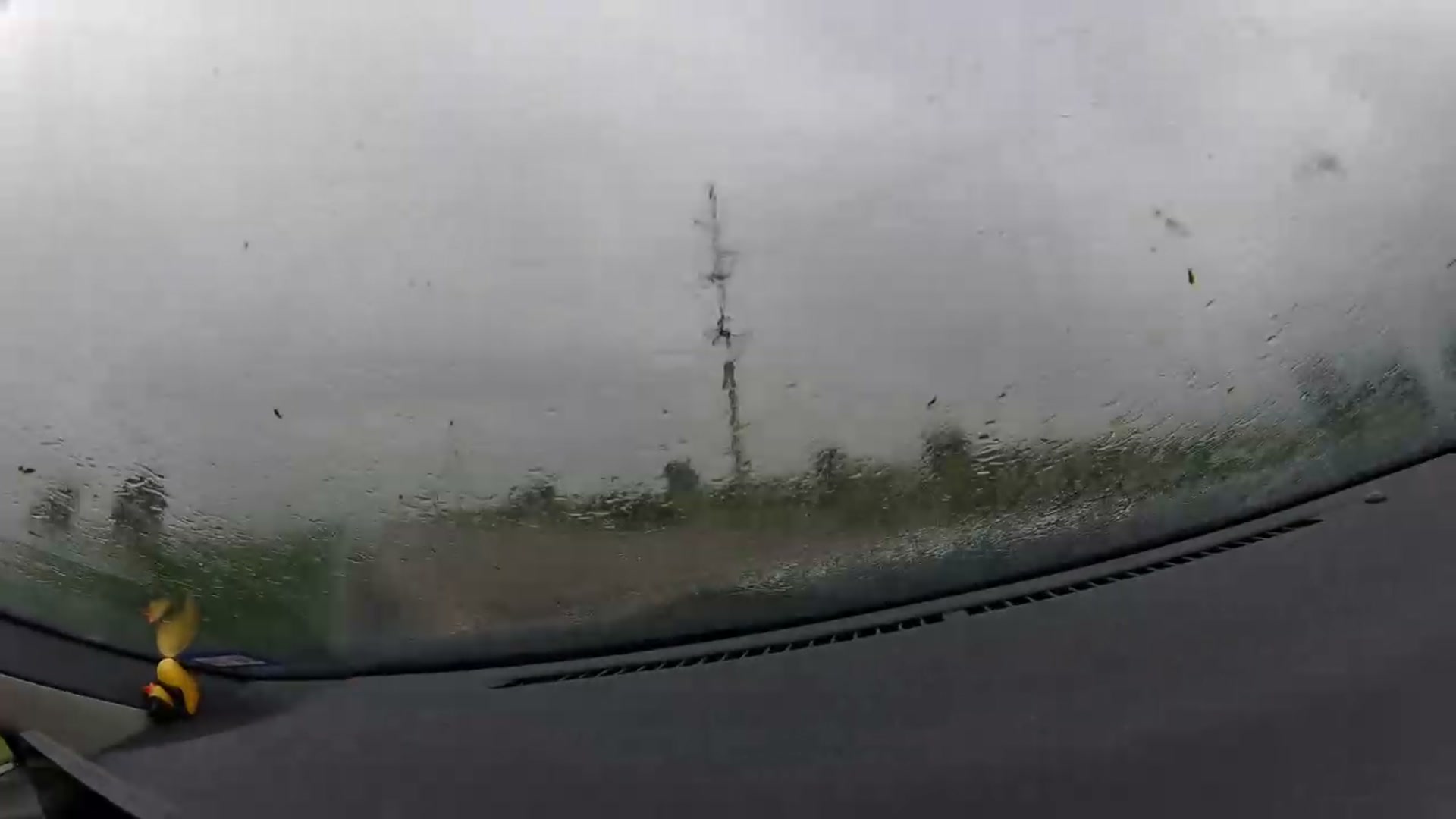
These are not fender-benders. A deceleration of 1.592 m/s^2 sustained over the duration captured here represents a forceful, emergency stop. The Bailey County event saw a vehicle traveling at 123.8 km/h (77 mph) come to a near-complete halt at 1.1 km/h. The Randall County and Wroclaw events ended at 0.0 km/h -- full stops from highway speed.
Patterns in the data
What stands out immediately is the geographic clustering.
Texas appears four times in eleven events: Bailey County, Randall County, Cleveland, and Dallas. Texas is home to some of the longest, straightest highways in the United States, where high travel speeds create conditions where sudden stops are especially violent. The state's highway system includes numerous high-speed rural corridors that funnel into urban bottlenecks, and long sight lines can create a false sense of security that delays driver reaction when traffic ahead slows abruptly.
Florida appears twice: Miami-Dade County and Hillsborough County (Tampa area). South Florida's rapid development has produced road networks where high-capacity arterials intersect with dense commercial development. Drivers transition from 100 km/h highway speeds to congested surface streets with little geometric warning.
Los Angeles appears twice, both times with deceleration values above 1.4 m/s^2. LA's freeway system is notorious for stop-and-go conditions, where flowing traffic at highway speed can encounter a standing wave of congestion without advance warning. The two LA events lack speed range data in the highlights summary but carry some of the highest deceleration values in the set.
The causes behind these events fall into recognizable categories: sudden traffic slowdowns on high-speed roads, merge zone conflicts, abrupt transitions between free-flow and congested segments, and lane-change conflicts forcing emergency maneuvers. None of these are random. They are products of specific road geometries interacting with traffic volumes and driver behavior.
Case study: Camarillo, Highway 101
The Camarillo event is worth examining in detail because it illustrates how much information a single dashcam event can carry.
On January 2, 2026, a Bee camera recorded a harsh braking event on US Highway 101 near Camarillo, California. The vehicle was traveling at 113.7 km/h (70.6 mph) and decelerated to 5.1 km/h (3.2 mph), with a sustained deceleration of 1.442 m/s^2. The video footage shows the cause: a white SUV cut across lanes during a traffic slowdown, forcing the camera-equipped vehicle into an emergency braking maneuver.

The AI scene analysis module -- which uses Claude to interpret extracted video frames -- described the setting as a "6-lane divided highway with retaining walls." This is significant context. A six-lane divided highway with retaining walls is a constrained environment. There is no shoulder escape route. When a vehicle cuts across lanes in that geometry, the trailing driver's only option is maximum braking.
This is not a driver behavior problem alone. It is a merge zone and lane design problem. Highway 101 through Ventura County carries heavy commuter and freight traffic. Segments where traffic transitions from free-flow to congestion are well-known to local drivers, but the physical design of the road does not provide adequate deceleration warning. No variable speed signs, limited advance warning of congestion, retaining walls that eliminate escape paths -- these are design characteristics that make harsh braking events more likely and more dangerous when they occur.
A single crash report from this location would tell an engineer that a rear-end collision occurred at mile marker X. This dashcam event tells them the approach speed, the precise deceleration curve, the road geometry, the precipitating behavior, and what the scene looked like at the moment of crisis. That is a fundamentally different quality of information.
Speed profiles as evidence
Each event in the system is not a single data point. It is a time-series.
The speed profile for a typical harsh braking event spans approximately 28 seconds of recorded data, sampled at high frequency from the vehicle's GNSS receiver. The result is a curve that shows the full deceleration pattern: the initial cruising speed, the moment braking begins, the rate of deceleration, whether there were any partial recoveries (pumping the brakes, or a brief release before braking again), and the final speed.
This matters because the shape of the deceleration curve carries information that a single "maximum deceleration" number does not. A smooth, monotonic deceleration from 100 km/h to 0 km/h suggests a driver who saw the hazard early and applied steady braking. A profile that shows constant speed followed by a sudden vertical drop suggests a surprise -- the driver had no warning and slammed the brakes at the last possible moment. The latter pattern, repeated across multiple events at the same location, is a strong signal that the road's design is not giving drivers adequate advance information about upcoming conditions.
When you combine the speed profile with GNSS coordinates (which provide the exact position on the road at each timestamp) and IMU data (which captures lateral and longitudinal forces), you get a complete kinematic reconstruction of the event. This is the kind of data that crash reconstruction experts spend thousands of dollars to produce after a serious collision. Here, it is generated automatically, for every event, by a camera that costs a fraction of traditional instrumentation.
A new paradigm for road safety monitoring
Bee Maps' network consists of dashcams deployed across vehicles worldwide. Each camera runs edge AI that classifies driving events -- harsh braking, aggressive acceleration, swerving, high speed, high g-force -- and uploads the event data along with video, speed profiles, GNSS tracks, and IMU recordings.
The implications for road safety monitoring are substantial. Instead of waiting for crash reports to accumulate at a dangerous location, transportation agencies could observe the precursors to crashes in near-real-time. A highway segment that generates an unusually high density of harsh braking events is a segment where the road design is failing, even if no collision has yet occurred. The data exists before the crash, not after it.

Consider what this dataset already reveals with just the eleven events in the extreme braking table. We can identify that Texas highway corridors have a pattern of emergency stops from high speed. We can see that Florida's urban highway network produces harsh braking events in two distinct metro areas. We can pinpoint a specific segment of Highway 101 where lane geometry and traffic patterns combine to create dangerous conditions. And we can see this across international borders -- Mooskirchen in Austria, Wroclaw in Poland -- suggesting that the patterns are not unique to American road design but reflect universal dynamics of speed, congestion, and inadequate geometric transitions.
Now scale that up. Bee Maps' network includes cameras across dozens of countries. Every camera is a sensor. Every harsh braking event is a data point that says: something about this stretch of road caused a driver to stop with emergency force. Aggregate enough of those data points over time and you have a heat map of road design failure -- a continuously updating, high-resolution safety assessment that no amount of manual surveying could replicate.
The comparison to traditional data sources is stark. A police crash report typically includes the location, the time, a narrative from the responding officer, and maybe a rough diagram. It is filed days or weeks after the event. It does not include video, does not include a speed time-series, and does not capture the road conditions or geometry in any structured way. A dashcam AI event includes all of those things, is generated within seconds, and is available for analysis immediately.
What comes next
The logical endpoint is straightforward: departments of transportation subscribing to a real-time feed of harsh braking events within their jurisdiction.
Imagine a state DOT receiving a weekly digest showing that a particular interchange generated 47 harsh braking events in the past seven days, up from a baseline of 12 -- possibly correlated with a recent construction detour that changed merge dynamics. Or a city traffic engineer receiving an alert that a newly installed traffic signal is producing a cluster of emergency stops that did not exist before the signal went live. These are actionable signals. They point to specific locations, specific time windows, and specific road conditions, all backed by video evidence and kinematic data.
The gap between "we think this intersection is dangerous" and "here are 200 deceleration curves proving that drivers are regularly forced into emergency stops at this exact location" is the gap between intuition and evidence. Dashcam AI events close that gap.
The data already exists. The cameras are already deployed. The AI is already classifying the events. The remaining question is whether the institutions responsible for road safety will adopt this new category of evidence -- and how quickly they will do so. Given what these eleven braking events alone reveal about highway design, traffic transitions, and merge zone failures, the case for adoption is difficult to ignore.
Follow us on X or Try Bee Maps for Free.